What is Transaction Log Processing (and Why It Matters)
What is Transaction Log Processing (and Why It Matters)
About Remac: Remac is a high-performance, database-agnostic transaction log processor. It turns native database transaction logs into governed data streams, replicas, audit records, recovery data, and replayable events.
This article explains the category that defines that work.
Your analytics dashboard says "last synced: 6 hours ago." Your search index still shows products that sold out this morning. A downstream service is making decisions with yesterday's data.
These are symptoms of the same problem: your data lives in a database, but the systems that need it are working with stale copies.
Database engines already create native logs for durability, recovery, replication, or a combination of these jobs. PostgreSQL has WAL. MySQL has a binary log and an InnoDB redo log. MongoDB replica sets have an oplog, while WiredTiger uses a journal for recovery.
These logs are not interchangeable. They also are not ready-made external event streams in every installation. The available data depends on the engine, configuration, access method, retention policy, and selected processing mode.
Transaction log processing reads a native database log and puts the available history to work.
What is a Transaction Log?
A transaction log is an ordered record that a database engine uses to track state changes. Its exact format and purpose depend on the engine.
In a write-ahead system such as PostgreSQL, the engine records the required recovery information before the related data-page write can reach durable storage. With synchronous_commit enabled, PostgreSQL waits for the required WAL flush before it reports a successful commit.
PostgreSQL does not need to flush every affected data page at commit. The background writer, the checkpointer, or a server process can write a dirty page. The write-ahead invariant is that the WAL required to recover that page reaches durable storage first.
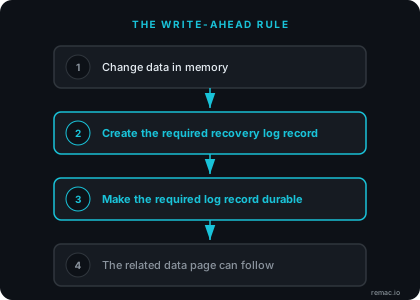
If PostgreSQL stops after the WAL flush but before it writes the data page, recovery can replay the WAL. A lost client acknowledgment does not prove that the transaction failed. The server can commit a transaction even when the client does not receive the response.
WAL, Binlog, Oplog
Production database engines maintain internal logs for recovery, replication, or both. The durability, ordering, contents, and access path depend on the engine and its configuration.
PostgreSQL calls it the WAL (Write-Ahead Log). WAL data lives in the pg_wal directory as a series of 16MB segment files by default. The segment size is configurable at database initialization. PostgreSQL identifies positions in the WAL with monotonically increasing Log Sequence Numbers (LSNs).
MySQL uses the binary log for replication and point-in-time recovery. The InnoDB redo log handles storage-engine crash recovery. MySQL supports statement, row, and mixed binary logging. A row-based stream records how individual rows changed, which is the normal input for row-level CDC.
MongoDB replica sets use the oplog for replication. MongoDB writes oplog operations so replica application produces the intended state when an operation is applied again. Change streams provide a higher-level change interface. A standalone MongoDB instance does not provide the same replica-set oplog and change-stream path.
SQL Server and Oracle have their own equivalents (the transaction log and redo logs, respectively), each with their own position tracking and decoding mechanisms.
The names and native roles differ. The common opportunity is that an ordered database log can become an input to an external processor when the engine exposes a suitable access path.
What is Transaction Log Processing?
Transaction log processing is the practice of reading a native database log and using it through a declared logical or physical processing path.
A database can maintain a native log without exposing it for external processing. Having the log and processing it are different things.
The logical path decodes selected committed changes into typed events. Those events can feed a stream, a replica, an audit record, or a replay archive.
The physical path keeps native log bytes or files in the database's format. It supports database-native replication, archival, and full-cluster recovery work.
The source integration handles the database-specific log format, position model, type system, and recovery rules. The processor applies a common contract to the work that follows.
Six Related Functions
Remac defines six related functions. When a conventional database term has a narrower meaning, the function scope is stated explicitly.
Change Data Capture. Convert selected committed changes into row-level events and deliver them to configured downstream sinks in real time.
Logical replication. Apply selected decoded changes to another database that uses the same engine so that its declared row state converges.
Heterogeneous replication. Map and apply selected committed changes to a database that uses a different engine so that its declared row state converges.
Audit logging. Preserve selected changes and their available source, operation, row, position, time, and transaction context in an append-oriented record.
Point-in-time recovery. In Remac's product model, this function has two explicit scopes. Physical PITR restores a compatible full database cluster from a physical base snapshot and native log. Logical point-in-time reconstruction replays an event archive to reconstruct selected row state or a declared projection. Each path stops at a selected recovery target.
REDO and event replay. In Remac's product terminology, this function replays archived normalized logical events through configured sinks to rebuild, repair, test, or reconstruct declared downstream state.
These functions have different delivery and recovery rules. They can still share one position model, one processing contract, and one operating layer.
Why Transaction Log Processing Matters Now
Transaction logs have existed for decades. Why does external transaction log processing matter now?
Batch ETL Hit a Wall
For most of the 2000s and 2010s, the standard way to move data between systems was batch ETL: Extract, Transform, Load. A scheduled job runs every hour (or every night), queries the source database for everything that changed, transforms it, and loads it into the destination.
This worked when "yesterday's data" was good enough. For many teams, it no longer is. The problems stack up:
Staleness. An hourly batch can leave downstream data nearly an hour old before job runtime and processing delay. For e-commerce, that can mean showing products that have already sold out. For financial services, it can mean displaying balances that have already changed.
Source work. A polling system needs a reliable change cursor, such as an update timestamp or, for append-only data, an increasing key. Without one, it can require expensive comparisons or broad scans. Even with a cursor, it must define late updates, deletes, and cursor ties correctly.
Invisible deletes. If you query for records that exist, you won't find the ones that were deleted. Many batch pipelines miss deletions entirely, leading to ghost data that accumulates in downstream systems and never gets cleaned up.
Lost transaction context. A single business operation might insert an order, update inventory, and create a shipment record across three tables. A table-oriented batch does not preserve the source transaction boundary unless it adds another mechanism.
Log-based processing can avoid repeated table scans and can include deletes and transaction metadata that polling often loses. Its completeness depends on source configuration, the selected tables and operations, replica identity, retention, and the processor's delivery policy. It also consumes database, network, storage, and processor resources that operators must monitor.
Real-Time Data as a Competitive Edge
Freshness-sensitive fraud detection can react too late when its input is an hour old, such as when a card is used in two countries within the same minute. Search indexes that lag behind the source database can show products that no longer exist. Recommendation systems that depend on recent behavior cannot respond to what a user did five minutes ago when they update only at night.
The gap between "real-time" and "last night's data" keeps widening as user expectations rise and the systems competing for their attention get faster.
AI and ML Pipelines Need Fresh Data
Freshness-sensitive AI and ML workloads add to this demand. A RAG (Retrieval-Augmented Generation) system that answers from current business data needs a knowledge base that reflects recent changes. Time-sensitive models need current feature values, while semantic search over new content needs its vector index to receive that content promptly.
These systems need current source facts with a known position, order, and failure policy. Transaction log processing can provide that path without using periodic table scans as the main change detector.
How Transaction Log Processing Works
There are two fundamentally different ways to process a transaction log, and understanding the difference matters because they serve completely different purposes.
Two Modes: Logical and Physical
Logical decoding converts database log information into structured change messages. A processor can then filter selected tables, apply approved transformations, and route events to configured destinations.
In PostgreSQL, logical decoding uses output plugins. pgoutput is the standard built-in output plugin used by PostgreSQL logical replication and emits messages through the logical replication protocol. MySQL uses row-based binlog parsing. MongoDB exposes change streams over the oplog.
Physical log processing copies or archives native log bytes without converting them into row events. The bytes remain tied to the source engine's physical format and compatibility rules. Physical processing supports native replication, log archival, and full-cluster recovery workflows.
Some deployments need one mode. Others need both. The required functions, recovery goals, and operating constraints decide the mode.
What a Change Event Looks Like
When a user updates their email address, the processor decodes the log entry and produces a structured event:
{
  "operation": "UPDATE",
  "table": "users",
  "timestamp": "2025-06-10T14:30:22Z",
  "transaction_id": "tx_8842",
  "before": { "id": 42, "email": "alice@old.com" },
  "after": { "id": 42, "email": "alice@new.com" }
}
This example shows before and after values, time, and transaction identity. A real source might not provide every field. The transaction_id connects changes from one source transaction. It preserves context, but it does not make separate destination writes atomic.
This is an illustrative logical event. The available fields depend on the source engine, table settings, decoder, and processing policy.
What Happens Between Capture and Delivery
Between source receipt and sink confirmation, a processor can filter, transform, batch, route, retry, apply backpressure, save checkpoints, and coordinate acknowledgments. Preserving transaction context does not automatically make all sink writes atomic. The sink and delivery method define that boundary.
Evaluate the Operating Contract
Source and sink support say little about how a processor behaves after failure. An evaluation needs the supported log modes, database versions, required configuration, and the exact boundary of each delivery guarantee. It also needs a clear source-acknowledgment rule and a definition of the event that makes a checkpoint safe.
The operating model matters just as much. Memory, queues, retained logs, and large transactions need explicit bounds. Source, sink, and checkpoint failures need defined recovery behavior. Shared functions should use compatible position and recovery meanings, and every required external process or service should be visible in the deployment model.
Where to Go from Here
Transaction log processing creates a governed path between committed database facts and the systems that use them. The native log provides the starting material. The processor must still interpret it, preserve the required context, control progress, and handle failure.
The published articles explain WAL, binlog, and oplog and Change Data Capture.
Join the Remac waitlist for product updates.
External reference note: The external technical information and linked references in this article were current when we published it. External systems, documentation, and defaults can change after publication.
Further Reading:
- PostgreSQL: Write-Ahead Logging (WAL). Official PostgreSQL documentation on WAL internals.
- MySQL Replication Formats. Official MySQL 8.4 documentation on statement, row, and mixed binary logging formats.
- MongoDB Replica Set Oplog. Official MongoDB documentation on oplog structure and behavior.